If you’ve ever watched your child struggle to begin a homework assignment, manage a packed schedule, or transition from one activity to another, you are witnessing the complex work of executive functions in action.
Executive functioning skills are the abilities that help us plan, start tasks, manage time effectively, and accomplish goals. Simply put, they play a critical part of our everyday lives.
While school plays an important role in building each child’s executive functioning skills, the truth is that much of this foundation starts at home. In fact, as a parent, you are your child’s first executive functioning coach – that’s an incredibly powerful idea.
The good news is that brains have plasticity – kids and teens can learn new strategies and build stronger habits for success. Every day truly provides multiple opportunities to model, teach, and support these important abilities.
More about Executive Functioning
As a parent, learning more about executive functioning skills can help you understand the skills your child is working on. You can learn more about executive functioning skills for parents here.
If you’d like to try building skills together, check out executive functioning activities for elementary kids and executive functioning activities for middle and high school learners.
Parent Strategies for Executive Functioning Skills
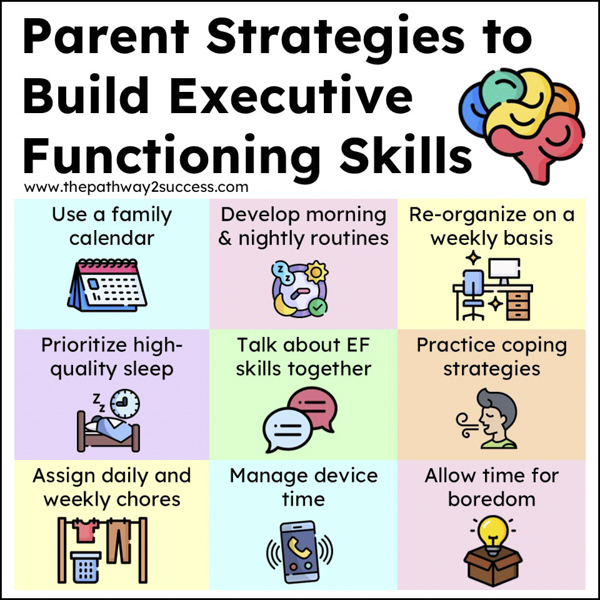
Sometimes small and simple changes can have the biggest impact! Below you will find several parent and guardian strategies to help build executive functioning skills at home:
1. Use a Family Calendar
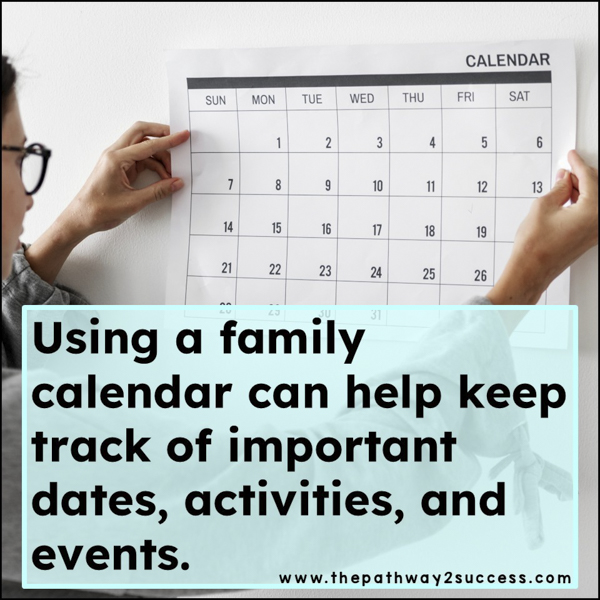
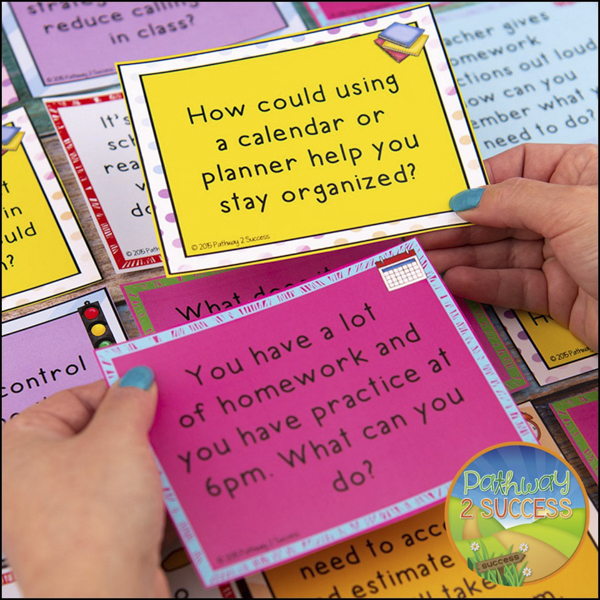
Strategy: Use a family calendar to highlight important activities and dates. Not only does this give kids real-life practice in planning and staying organized, but it helps everyone in the house collaborate and know what’s going on.
Skills: organization, planning, time management
- Keep a family calendar visible in a common area, such as in your kitchen.
- Add important dates, events, and activities on the calendar. You might have a family member’s birthday dinner at 6pm this Friday and a sports tournament on Saturday morning.
- When your child is ready, encourage them to add important events onto the calendar themselves. For instance, when your child tells you they have an important sports game or test, ask them to list it on the calendar.
- Consider adding in color-coding for different types of events.
2. Designate Landing Areas
Strategy: Designate different areas around your home so that there is a space for everything.
Skills: organization, working memory, attention, task initiation
- Set up a visible area where kids can leave their high-traffic items like backpacks, coats, and keys.
- Plan a spot for important paperwork, such as permission slips that need to be signed. For instance, these might be clipped to the fridge as a reminder.
3. Organize Weekly
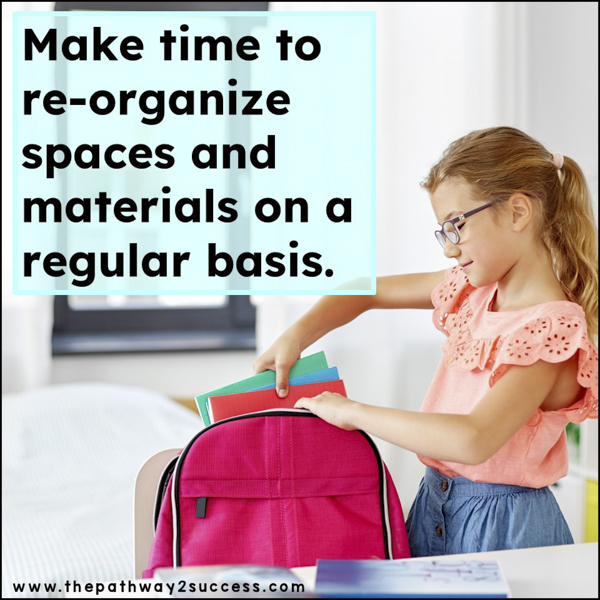
Strategy: Practice organizing and re-organizing on a regular basis. This helps teach that organization isn’t “one and done,” but instead something we return to again and again.
Skills: organization, task initiation, attention
- Plan a weekly organization time. For instance, you might choose Friday afternoon before the weekend as the time to re-organize areas around the house.
- Discuss expectations for organizing spaces such as tidying up bedrooms and common areas.
4. Develop Morning and Nightly Routines
Strategy: Create predictable routines to establish expectations, reduce stress, and conserve thinking power.
Skills: organization, working memory, self-regulation
- Plan morning and nightly routines that work for you and your child. For instance, your morning routine might be to wake up at 6am, make your bed, shower, get dressed, and have breakfast before leaving.
- When first setting up your routines, make sure to model and perform the steps right alongside your child.
- For kids who need extra support, consider making a visual schedule with pictures or a simple checklist.
- Try a “mindful morning” routine to start your day in a calming way.
5. Prioritize Physical Activity
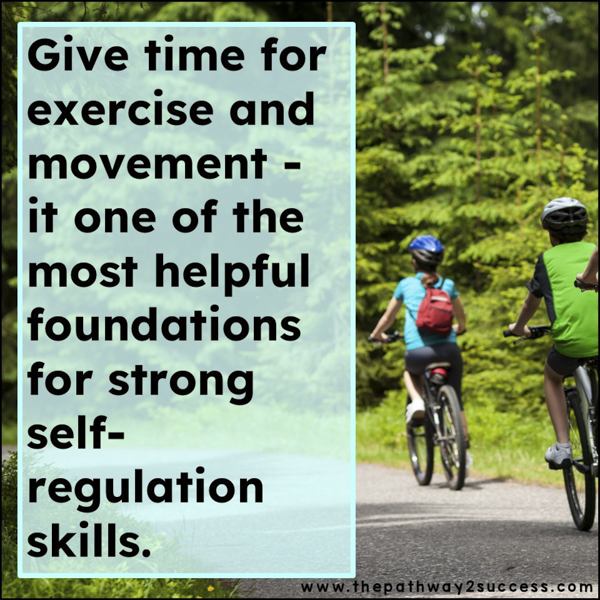
Strategy: Integrate movement and physical exercise into the day. Keep in mind that exercise isn’t just about getting fit; it’s one of the most helpful foundations for self-regulation.
Skills: self-control, attention
- Model the importance of exercise by engaging in physical activity yourself as a parent. Consider going for a walk, practicing yoga, or visiting the gym on a regular basis.
- Exercise together as a family. You can opt for taking a walk around the block, going for a hike, or just playing a game in the backyard.
- Encourage your child to find joy in physical activity, whether that means riding their bike or joining a sport.
6. Practice Coping Strategies Together
Strategy: Teach strategies to help manage stress and tough emotions. It’s not just good enough to learn these strategies one time, but to continually revisit and practice them.
Skills: self-control, self-awareness, attention
- Discuss, introduce, and practice different coping strategies. Try activities like deep breathing, coloring, listening to music, and exercising. Talk about what works for each of you as an individual person.
- Embrace coping strategies breaks. If you or your child seem frustrated in the moment, practice taking a break to reset your nervous system, invite calm, and build focus.
- Model deep breathing. Learning to control our breath is arguably one of the most important coping skills for success. Take time to practice slowly breathing in and out.
7. Assign Daily and Weekly Chores
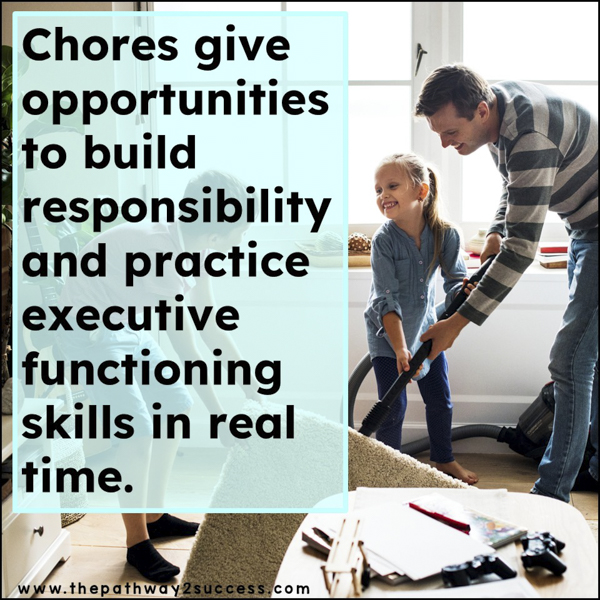
Strategy: Assign chores to provide real-life practice with daily responsibilities and expectations.
Skills: task initiation, self-control, time management, perseverance
- Talk about how chores build responsibility. Sometimes, we have to do things we don’t feel like doing in the moment. This is part of life! We can use strategies to get through those responsibilities.
- Write out a chore list. For instance, a teen might be responsible for feeding the dog and making their bed each day.
- Practice chunking for bigger tasks. If a chore feels overwhelming, such as cleaning your room, try breaking it apart into multiple steps.
8. Focus on High-Quality Sleep
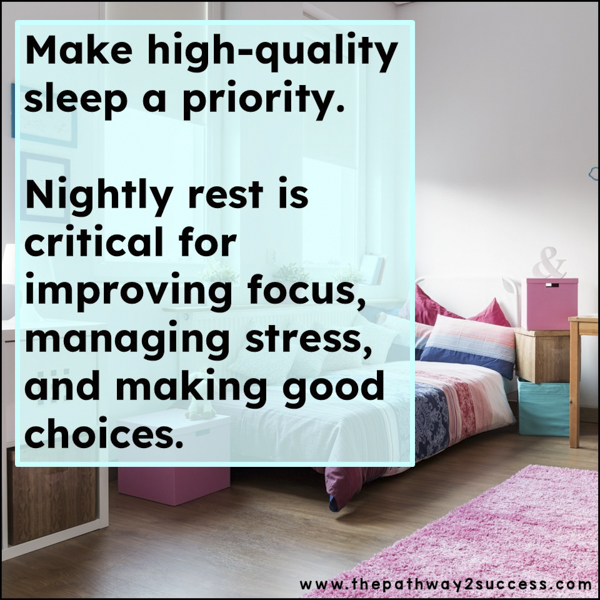
Strategy: Develop structures and routines that make high-quality sleep a priority. Simply put, sleep is essential for focusing well, managing stress, and making good decisions.
Skills: attention, perseverance, self-control, working memory
- Talk about the importance of high-quality sleep. Sleep has a ton of important benefits. It improves focus, problem-solving skills, creativity, memory, immune system, and more.
- Choose a bedtime that works. Think about how much sleep your child will need and use that as a starting point.
- Practice keeping phones in a common area, like the kitchen. Keeping electronics out of the bedroom is important to remove them as a distraction.
- Develop a regular nighttime routine. This might look like charging your phone in the kitchen, brushing your teeth, reading a book for 15 minutes or so, and then finally getting to bed.
9. Set Up Dedicated Work Spaces
Strategy: Design a consistent work zone to help the brain associate that location with focused work.
Skills: attention, organization, task initiation, self-monitoring
- Set up a dedicated work area for academics, studying, and homework.
- Keep your dedicated work space free from distractions. For example, when working, consider keeping phones in another room.
- Add supplies for schoolwork in one area, such as paper, pencils, coloring utensils, and more.
10. Talk About EF Skills
Strategy: Openly discuss and learn about executive functioning skills together. Just a note that it’s entirely okay if you yourself don’t feel 100% confident with executive functioning skills – these are abilities we’re all learning and growing. Simply discussing these abilities helps open the door to building and strengthening skills.
Skills: planning, organization, self-control, attention, perseverance, and more
- Naturally discuss different executive functioning skills when they come up in real life situations. For instance, you might talk about perseverance when your child pushes through a challenging test.
- Ask executive functioning-focused questions to get kids thinking.
- How did you practice self-control today?
- What strategies help you stay focused on a quiz or project?
- How did you use planning skills today?
- What problems did you encounter today? How did you problem-solve?
11. Practice Reflection Time
Strategy: Practice reflecting after a situation or decision in order to learn and grow.
Skills: metacognition, self-awareness, flexibility
- Reflect by chatting and discussing how the day or week went. You might ask: What went well today? What skills did you use? What is something you feel proud of today? Remember to model reflection time by sharing your own thoughts as well.
- Use reflection 3-2-1 after a situation, decision, or event. Have your child list 3 things that went well, 2 things that didn’t go so well, and 1 lesson they learned for the future.
- Give journal writing a try. If your child enjoys writing, use journaling as a strategy to reflect.
12. Give Transition Warnings
Strategy: Give advanced warnings before switching activities. This can help your child learn to shift their focus from one thing to another.
Skills: flexibility, self-control, planning, time management
- Give reminders about important events or times when you need to leave the house. For instance, you might say, “Just giving a time check. We need to leave the house at 5pm for the dinner tonight. That’s in one hour.”
- If your child struggles with transitions, set a visual timer when you need to transition from one thing to another.
13. Practice Mindfulness
Strategy: Give time to practice mindfulness. Simply put, mindfulness is a self-regulation technique that helps us focus on the present moment. It’s an evidence-based strategy to help kids and teens build focus, boost self-control, and strengthen working memory. Possibly most importantly, though, it’s an incredibly powerful tool that helps kids and teens manage stress and tough emotions.
Skills: attention, self-control, working memory
- Practice mindful breathing together. Try sitting in a comfortable position and letting your body relax. Slowly breathe in and slowly breathe out. You can try counting your breath slowly as you inhale and exhale. After you’ve given this a try, talk about how it helps you feel.
- Once your child understands the idea of mindful breathing, feel free to add in other mindful breathing techniques like 4-7-8 breathing and heartbeat breathing.
- Use the mindfulness 5-4-3-2-1 technique. Take a look around you. Notice 5 things you can see, 4 things you can touch, 3 things you can hear, 2 things you can smell, and 1 thing you can almost taste. This is a powerful tool for your child when they’re feeling stressed or overwhelmed.
14. Manage Technology Time
Strategy: Establish expectations and boundaries with technology to help your child build skills for focus, self-regulation, time management, and more.
Skills: attention, time management, self-regulation
- Talk about why it’s important to disconnect from technology sometimes. Space away from our devices allows us to be more present in the moment, improves our focus, strengthens social skills, and gives us time for new hobbies.
- Schedule family device-free time together. Have a phone-free movie night or take a walk in the woods. This is important to model the skills we are asking of children and teens.
- Keep phones out of the bedroom at night. Sleep time is critical for doing and feeling our best. Practice charging phones in another room, like a kitchen or living room, to keep them out of bedrooms at night.
- Openly discuss expectations and limits. Be clear on which apps your child is and isn’t allowed to use.
15. Allow Time for Boredom
Strategy: Give time and space for being bored.
Skills: task initiation, attention, problem-solving
- Reframe moments of boredom as opportunities to generate ideas, problem-solve, and be creative. Sometimes we think of being bored as simply negative, and that’s just not true. Being bored forces kids and teens to go inward, come up with new ideas, and figure things out.
- Give a boredom challenge. If your child mentions that they’re bored, encourage them: What things could you do right now?
16. Talk About Emotions
Strategy: Give time and space to openly talk about feelings. Teaching kids to identify, name, and express their emotions is an important part of self-regulation.
Skills: self-control, self-awareness, flexibility
- Model talking about emotions. You might say, “I’m feeling overwhelmed right now and need a minute to myself to breathe.” This helps teach that feelings are normal, and we can use strategies to work through them.
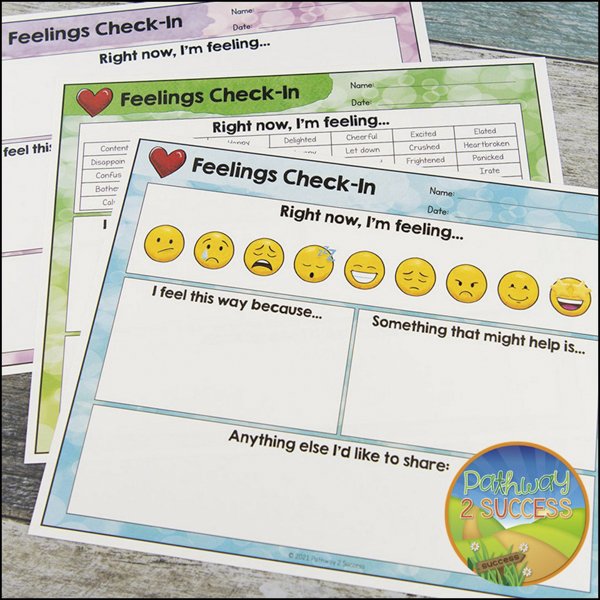
- Try a daily emotions check-in to give your child a space to share how they’re feeling.
17. Spend Time in Nature
Strategy: Embrace time outside in nature together. It’s true that being outside serves as a healthy brain break, but nature has also shown to help restore attention skills and reduce stress.
Skills: attention, self-control, working memory
- Enjoy time outside in nature together. Try taking a walk around the block, going for a hike, or just watching nature in the backyard. This helps set the stage for learning to appreciate the natural world around us.
- Practice mindful listening outside. When outside, pause and try to list all the different things you can hear – birds singing, the rustling of leaves, and cars passing by.
- Do yard work together. Get outside to weed a garden or pick up sticks in the backyard.
18. Encourage Following Interests and Passions
Strategy: Support your child’s interests and passions, allowing them to learn topics and activities that captivate their individual curiosity.
Skills: attention, perseverance, growth mindset
- Find out what your child would like to learn more about and give it a try together. You might opt to read books about butterflies or watch a video on how to draw.
- Encourage your child to join a club or after school activity that sparks their interest.

19. Allow Challenges to be Challenging
Strategy: Provide support without solving every problem for your child. It goes without saying that it’s incredibly tough to see a child or teen struggling with a challenge, but this is part of the process that helps us grow.
Skills: perseverance, problem-solving, flexibility
- Encourage your child to embrace challenges. Discuss challenges together and remind them that these experiences are how we build and grow our skills. They might feel challenging in the moment, but that’s actually a good thing.
- Offer to listen and brainstorm strategies for perseverance. For instance, if your child feels overwhelmed with a busy schedule this week, you might say, “I hear you saying you feel overwhelmed this week. What are some things we can do to work through that?”
- Celebrate wins together. Share excitement when your child works through a challenge.
A Note for Parents
A final reminder that even baby steps are steps in the right direction. Get started with some of the strategies above and take note of how it helps your child in their life. Celebrate the small wins together!




Leave a Reply