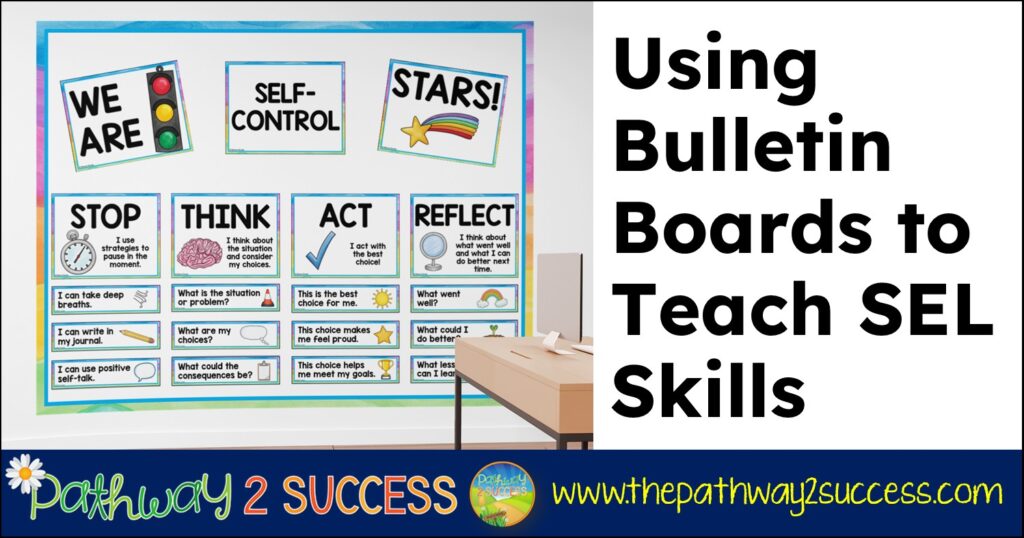
Bulletin boards are valuable real estate in the classroom. They are a welcoming visual space students return to time and time again. This makes bulletin boards the ideal place to integrate social-emotional skills that kids and teens need.
Why should teachers use bulletin boards to target SEL skills?
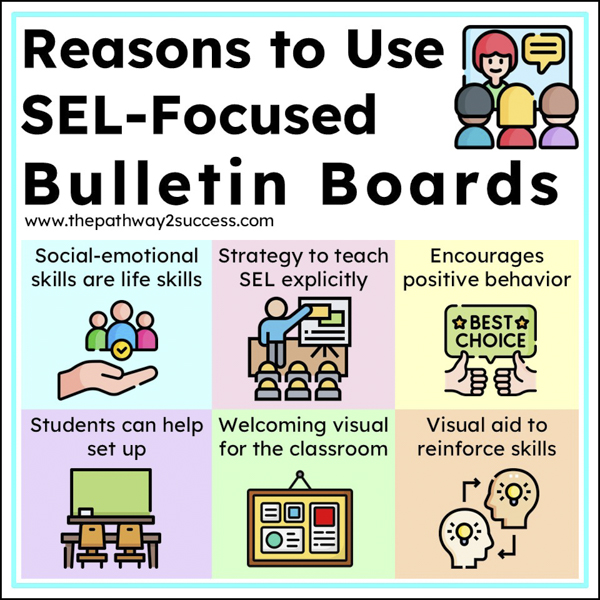
- Social-emotional skills are life skills. These abilities are important for every learner, whether the student is in 1st grade or 12th grade. Using a SEL-focused bulletin board helps promote long-term development of skills like empathy, conflict resolution, self-control, attention, and more.
- Time for social-emotional skills is often limited in the classroom. A bulletin board serves as an efficient way to integrate these skills without taking up time from other academics like reading and math. In other words, SEL-focused bulletin boards help make the most of the time in the classroom.
- Bulletin boards are a helpful visual aid. This serves as an excellent way to provide reminders about important skills that you can return back to time and time again.
- Bulletin boards can be interactive when students help to set them up. By engaging students in the setup, students have more buy-in in the learning process. This can also encourage teamwork and collaboration as students work together.
- SEL bulletin boards encourage self-reflection. Bulletin boards serve as a space for students to reflect on their own skills. This promotes metacognition and helps students understand their own individual growth.
- One-time prep for teachers. It’s true that putting them up requires some time and effort, but once the bulletin boards are posted, the prep work is done.
Tips for using bulletin boards to promote SEL skills
Use these tips, strategies, and ideas to use SEL-focused bulletin boards as a teaching tool in your classroom.
Plan out your SEL skills bulletin board.
Think about the social-emotional skills that your students need the most. This is going to depend on your individual learners. For instance, if your students are struggling with staying focused in class, you might choose to post a bulletin board with strategies for attention. Similarly, if your learners need a boost with making positive choices, you might opt for a focus on integrity.
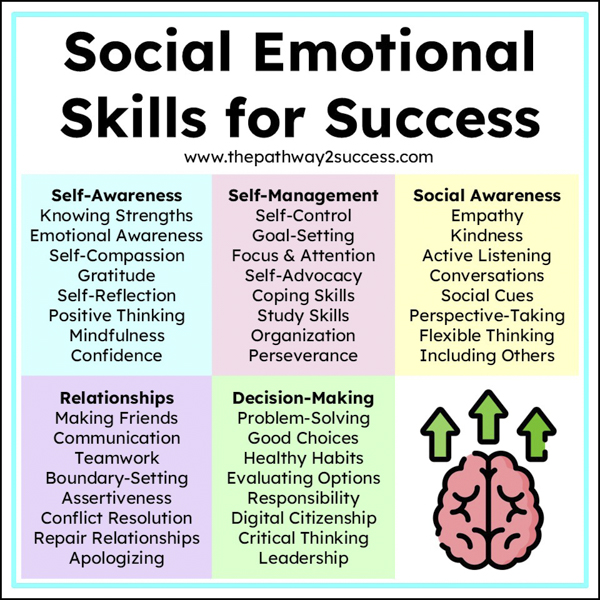
Start by asking yourself – what SEL skills do my students need the most? Make a list and choose one to target that skill. While there are many different social-emotional skills, here are some ideas to consider:
- Empathy – considering how others feel and showing that we care
- Self-Control – using strategies to stop and think before acting
- Attention – using strategies to stay focused on tasks, goals, and responsibilities
- Leadership – taking initiative and inspiring others through positive action
- Conflict Resolution – finding ways to solve problems in peaceful ways
- Growth Mindset – believing that challenges are opportunities to learn and grow
- Executive Functioning – using skills to plan, organize, prioritize, and complete goals
- Self-Love – showing yourself respect and treating yourself with kindness
- Resilience – using strategies to bounce back when faced with setbacks or failures
- Coping Strategies – using healthy strategies to cope with stress and challenges
- Mindfulness – learning to stay calm and focused on the present moment
- Managing Stress – using strategies to manage daily challenges in our lives
If you are ready to get started, grab this complete SEL bulletin board set filled with visuals to teach self-control, conflict resolution, empathy, and more for the entire year. It uses evidence-based practices to support SEL, and everything is already done for you – just print, teach, and learn together.
Focus on strategies kids can use.
Instead of just posting about various social-emotional skills, it’s important to go beyond this and directly teach strategies kids can apply to their lives. Here are some examples of what that might look like in a bulletin board:
- If you’re highlighting coping strategies to manage stress, use examples of real-life techniques kids can try like deep breathing, coloring, and exercising.
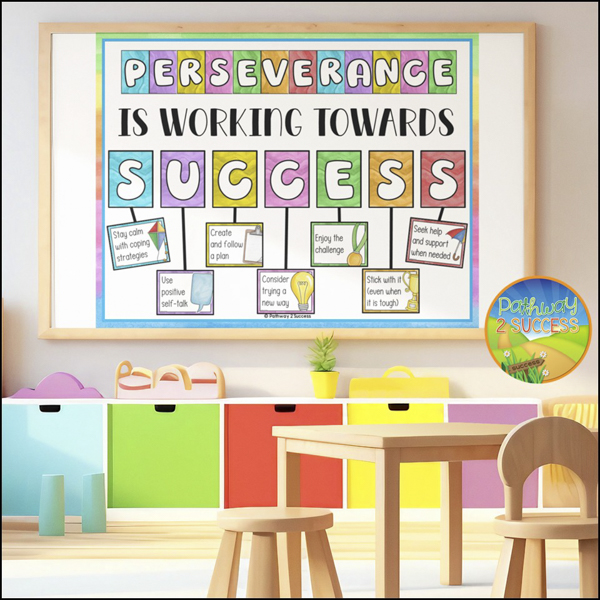
- If you want to target perseverance, identify strategies like making a plan, using positive self-talk, and trying a new way if one doesn’t work out.
Again, don’t just define the social skill; clearly showcase strategies kids and teens can use right away.
Make it memorable.
The whole point is that students can remember the strategies so they can use them later on. Try some techniques to make your SEL bulletin board memorable for your learners.
- Include a catchy phrase – Add a simple repeatable phrase that draws students in. This might include something like:
- Growth mindset – “Our growth mindset is blooming”
- Self-control – “Self-control is our superpower”
- Resilience – “Building resilience helps us bounce back”
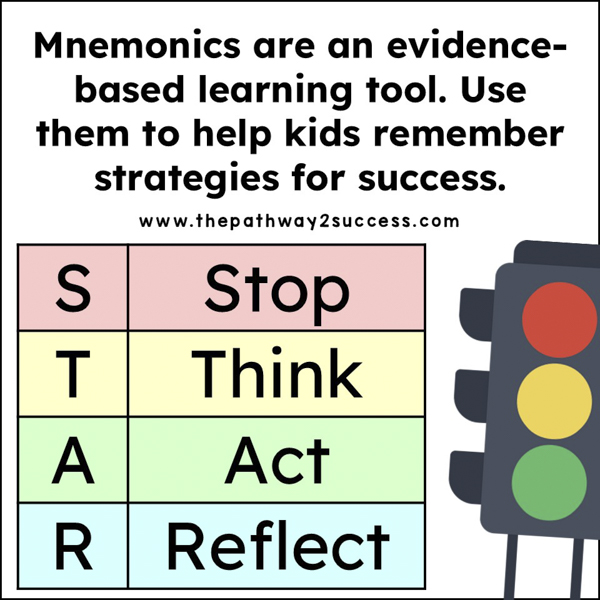
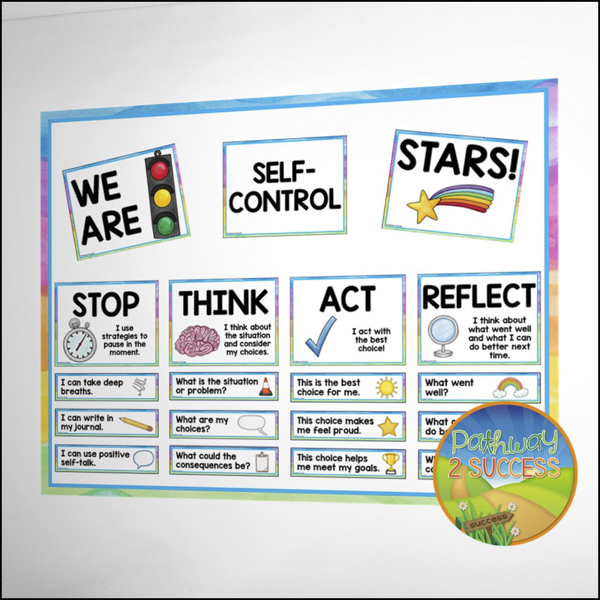
- Use mnemonics – A mnemonic is an evidence-based memory device we can use to help remember strategies. For example, you might use the mnemonic STAR to teach students how to show self-control by stopping (S), thinking (T), acting (A), and reflecting (R).
- Integrate art and creativity – A beautiful bulletin board helps the message stand out. If you can’t print your bulletin board in color, try printing the black and white version on colored paper to make it pop.
Get students involved.
Give your learners an opportunity to be part of the bulletin board team – this helps them feel invested in the skills they’re learning about from the start.
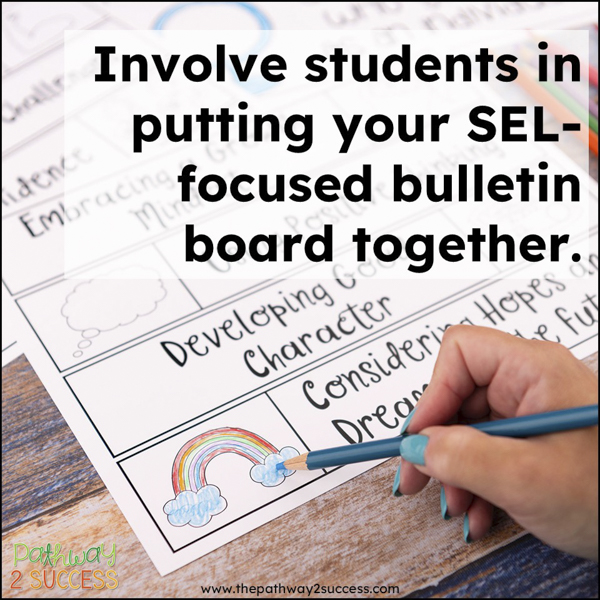
One of my favorite tried and true tips for getting students involved is having them color and design the bulletin board. This can be done individually or in groups as a team-building activity.
Another strategy is to give students a choice in which SEL skills will be targeted on the bulletin board. You might give a list of SEL skills and have your students vote each month.
What’s most important is getting kids involved in some capacity. This gives them a voice and a profound sense of ownership.
Teach and discuss the bulletin board.
Use the bulletin board as a starting point to discuss, teach, and practice the skill with your students. For instance, you might start off by saying, “Take a look at our new bulletin board. Who can tell me what it says? What do you think that means? When might you use this skill here in school? When might you use this skill outside of school?”
Ultimately, this might only take a few minutes, but can help set the stage for success when learning about your SEL skill.
Refer back to the bulletin board.
One of the biggest positives to posting up a bulletin board is that it stays there! Use this to your advantage by pausing and referring back to the bulletin board often throughout the month (or however long you have it up for).
Example 1: Let’s say your bulletin board is targeting perseverance skills. You might pause and come back to review the perseverance strategies before a tough test or big project.
Example 2: Imagine your bulletin board is focused on kindness. At the end of each day, you might come back to your bulletin board and ask students to share something kind they’ve seen or experienced that day.
The key is that the bulletin board isn’t just a pretty set of posters, but a learning tool students can use again and again.
Keep it fresh.
Consider changing up your bulletin board on a regular basis to keep it fresh for you and your learners. For example, you might try planning out a new skill of the month for your bulletin board. This gives you ample time to teach, model, and practice the bulletin board skill, while also giving your students a new skill to look forward to learning in the future.
SEL Bulletin Board Ideas to Try
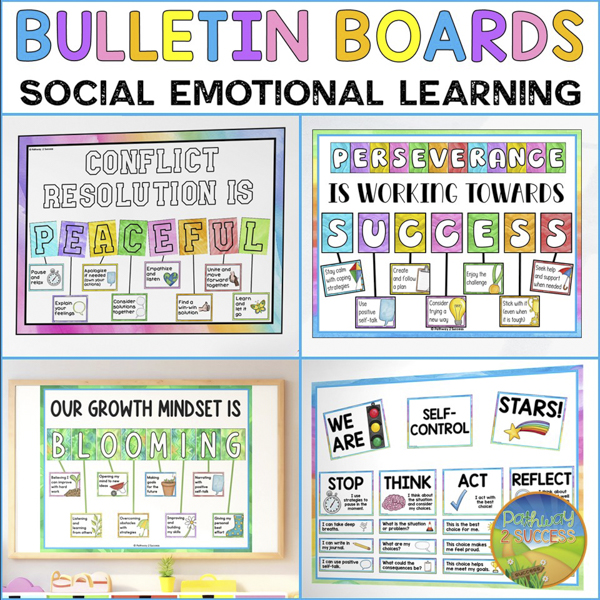
I’ve put together some bulletin board ideas to try in your classroom. You can always make your own, but these are set up and ready to go for limited prep work on your end. Each bulletin board comes in both color and black/white, giving you printing options for your classroom. If you love the ideas, grab this complete set of social-emotional bulletin boards for the year.
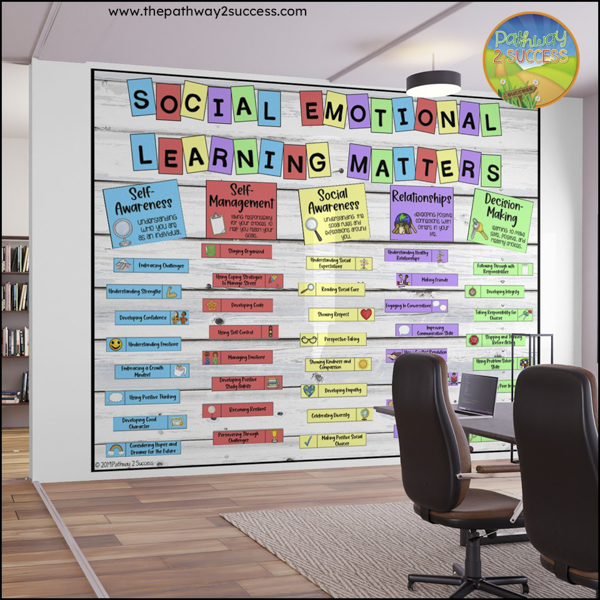
1. Social Emotional Learning Skills Bulletin Board
Use a bulletin board to introduce the idea of social-emotional learning. Aim to target all 5 core domains of SEL: self-awareness, self-management, social awareness, relationships, and decision-making. Because this one targets so many different skills all in one, it’s something you could keep up in your classroom or school hallway throughout the entire school year.
2. Self-Control Bulletin Board
Integrate self-control skills with a self-control STAR bulletin board. It goes without saying that self-control is always a skill worth teaching. With a bulletin board, you can provide students with a powerful and easy-to-remember framework – Stop, Think, Act, and Reflect. This is perfect for helping students navigate challenges and make more thoughtful decisions.
3. Conflict Resolution Bulletin Board
Build conflict resolution skills by centering them on a classroom bulletin board. Make it a point to include peaceful techniques such as pause and relax before reacting, explain your feelings, actively listen, and find a win-win solution. Ultimately, this conflict resolution bulletin board can be an actionable toolkit for learners when they face disagreements with others.
4. Focus and Attention Bulletin Board
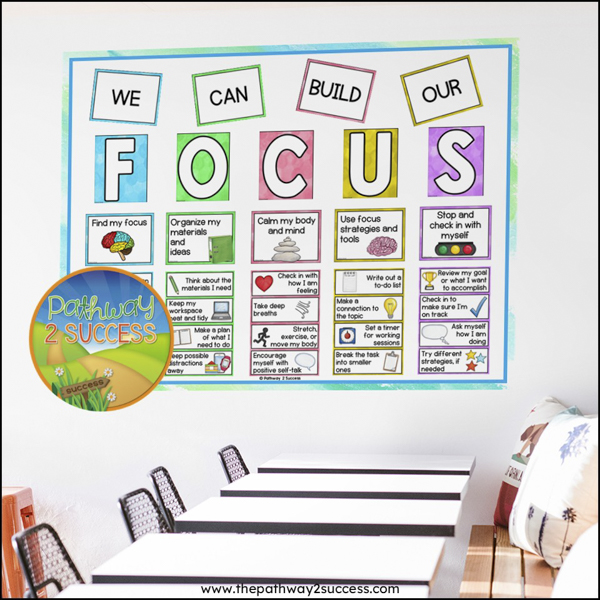
Use a bulletin board to set your focus on how to focus. Add a phrase like “We can build our FOCUS!” and add meaningful strategies kids can put into place right away. This might include writing out a to-do list, getting organized, taking breaks, and breaking the task into smaller parts.
4. Integrity Bulletin Board
Integrity is doing the right thing, even if no one else is watching. It’s an ability we’re all working on every day. Help kids and teens build integrity by highlighting how to do the right thing and take ownership of your actions. Get started with an integrity-focused bulletin board for the classroom.
6. Perseverance Bulletin Board
Perseverance is about not giving up, and it’s a critical skill for kids and teens. Use a perseverance bulletin board to celebrate effort and failure as part of the learning process. You can add in strategies like staying calm with coping strategies, using positive self-talk, creating a plan, and asking for help when you need it.
7. Self-Advocacy Bulletin Board
Help students learn to advocate for themselves using a self-advocacy bulletin board. Being able to advocate for yourself is a critical social-emotional skill for success. It’s the ability you use to raise your hand and ask a question, and the ability you use to speak up for yourself when something isn’t right. One strategy that sticks is having “SUPER self-advocacy skills” – staying calm, understanding the problem, problem-solving, expressing yourself, and reflecting to learn and grow.
8. Empathy Bulletin Board
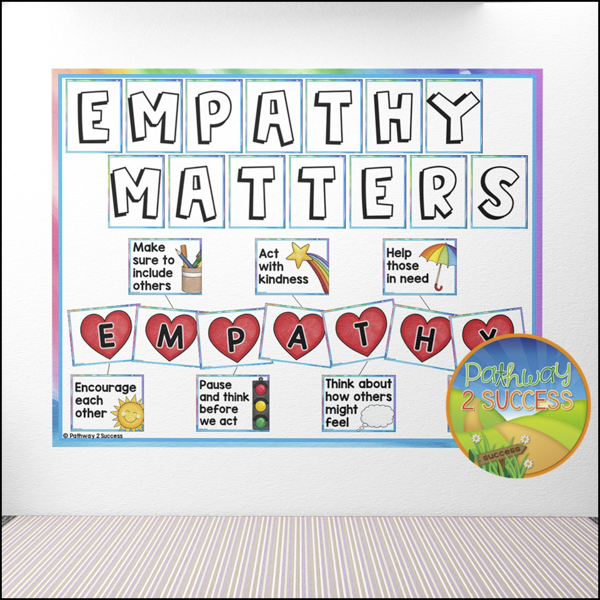
Empathy is the basis for connection, so it’s worthwhile to have a bulletin board dedicated to this skill alone. Explain that “empathy matters” and add examples of what it might look like in action.
Bringing SEL Bulletin Boards to Life
Using bulletin boards to teach and support social-emotional skills is a great solution for educators. Not only is time limited in the classroom for SEL instruction, but let’s be real – kids and teens need as much practice with these skills as possible. Using a SEL bulletin board gives you the chance to promote skills like empathy, conflict resolution, self-control, and more. It’s ultimately one small step that can lead to big impacts for you and your learners.



Leave a Reply