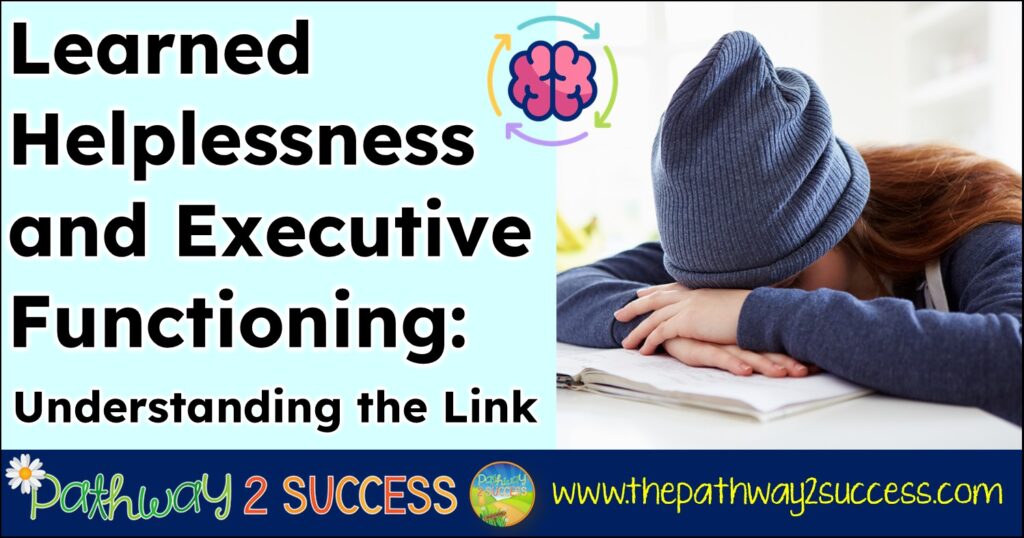
“I can’t do this.” It’s a phrase every teacher has heard, often in response to a perceived challenge like writing an essay, solving math equations, or finishing a project. This can feel incredibly frustrating as an educator (or parent), especially when you know that the child should be able to give the task a try. You’ve taught the skills and provided the practice, so what’s really going on here? Sometimes, that answer lies in understanding learned helplessness.
Let’s start by considering what happens when we are faced with a challenge, something we all experience at varying levels throughout the day and week. Normally, when we encounter something difficult, we can use strategies to power through. We might remind ourselves to keep going or look up information for more support. We might try different techniques or ask for help. Sometimes, we might even take a break and come back to try again later. Eventually, though, we work through the challenge and feel success. This is incredibly important. By powering through challenges and ultimately finding success, we train our brains that we can do tough things. We don’t just think it, we believe it in our core.
For some learners though, facing challenges unfortunately doesn’t always lead to success. When those challenges continually lead to failure, something else can sometimes happen – learners can develop learned helplessness. This is the mindset that individuals develop when they feel they cannot independently work through challenges.
The idea is that learners internally think, “I can’t do this, so why bother?” Ultimately, the brain becomes conditioned to think you can’t do something, even when you can.
What Learned Helplessness Looks Like
Learned helplessness can manifest differently in different individuals. Before delving in, something important to point out is that learned helplessness is not laziness. It’s not “I don’t feel like doing this,” but instead, “I don’t think I can do this.” This small distinction plays an important role in changing how we look at these challenges, and ultimately the strategies we use to help learners through.
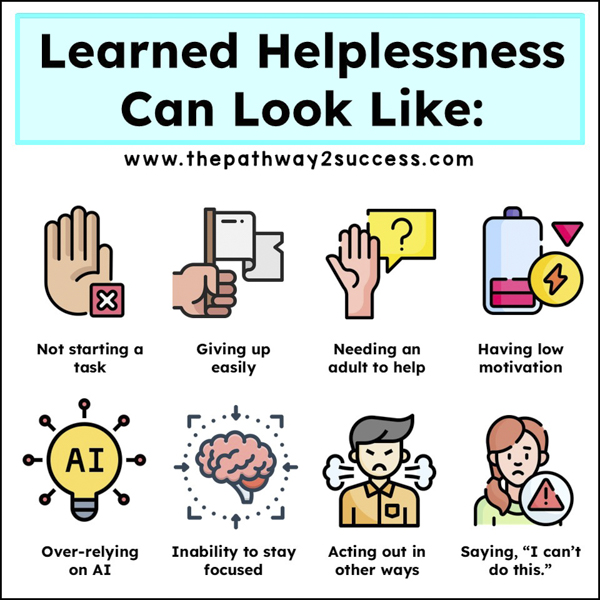
Here are some ways learned helplessness might show up with kids and teens:
- Giving up easily – As soon as something feels even slightly challenging, a student may want to give up.
- Not starting a task – If a learner perceives something as challenging from the start, it may feel easier for them to not start at all. This might come off as refusing the task or even getting distracted with other things as an attempt to avoid.
- Always needing an adult to help – Some students have learned that they can’t do tough things on their own, making them reliant on an adult to sit with them through tasks.
- Over-relying on AI – When learners feel they can’t do things on their own, it makes it easy to over-rely on tools like AI.
- Having low motivation – Continually failing at goals is a recipe for low motivation across the board, even on tasks that aren’t necessarily challenging. It just becomes easier not to try at all.
- Needing constant reassurance – “Am I doing this right?” Some learners lack confidence in themselves, creating the need for frequent reassurance from a trusted adult.
- An overall negative outlook – Students might say things like “This is stupid!” or “I can’t do this.” An overall negative disposition when beginning or completing tasks can come from multiple past failures without the right supports in place.
- Avoiding making decisions – When someone feels like they can’t get things right on their own, it weakens self-confidence. Ultimately, this can lead to letting others make decisions for them.
- Acting out – Sometimes learned helplessness can manifest as acting out in silly ways. After all, kids and teens may feel safer acting as the class clown than “looking stupid” in front of peers.
Learned Helplessness and Executive Functioning Challenges
Learned helplessness stems from continued past failures. It’s important to mention that this makes a lot of sense in the context of executive functioning challenges. When kids and teens struggle with executive functioning skills, they’re more likely to struggle. And without the right supports, they can be more likely to fail. This can set the stage for learned helplessness to develop.
Let’s consider a few examples to illustrate this.
Imagine a teen named Jay who struggles to focus in math class. Even though Jay has tried to focus and listen, the concepts aren’t getting through to him. He failed the last few exams and really realizes he’s struggling. When he goes to ask for extra help or extra credit, his teacher reminds him that he hasn’t been paying attention in class. Jay eventually learns that he can’t focus in math class and he can’t learn the concepts. He stops trying. Again, “I can’t do this, so why bother?”
Now, imagine an elementary learner named Carissa. Last year, Carissa had a lot of difficulty with self-regulation and managing her emotions. When anything was challenging, Carissa would cry and give up. To try to support Carissa, the paraeducator in class worked one-on-one with her to provide encouragement. Flash forward to the current year and Carissa’s teachers notice that she gives up on tasks unless an adult is sitting with her and encouraging her along the way.
Breaking the Cycle of Learned Helplessness
After failing time and time again, kids just give up. They learn it’s easier to not try at all. This is how learned helplessness can become a vicious cycle for kids and teens. And it’s truly a drain for everyone involved, especially the kids themselves.
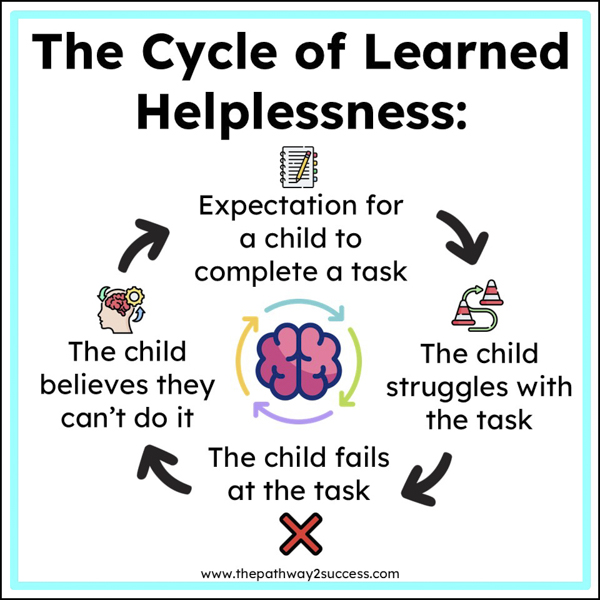
With strategies and supports, we can build healthy skills for success together to break this cycle. It’s all about starting small and building confidence slowly over time.
Cultivate a Growth Mindset
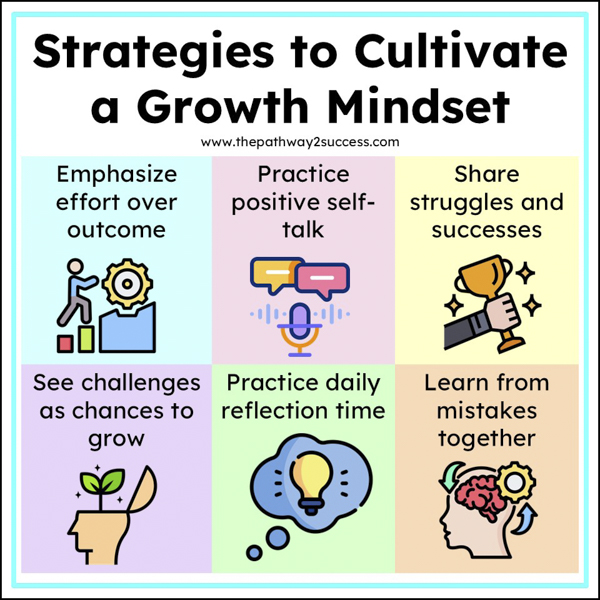
Having a growth mindset means knowing that you can improve your skills with hard work and practice. For many, this doesn’t come easily. Kids and teens with learned helplessness often feel that they are just “good” or “bad” at something, and that’s just how it is. Cultivating a growth mindset teaches learners that small shifts can lead to big changes over time. After all, in order to make positive changes, it helps to first believe that you can.
- Emphasize effort over the outcome – The work you put in is much more important than the actual outcome. Practice makes progress. Encourage kids and young adults by praising their effort, practice, and struggles along the way. For instance, you might say, “I saw you work really hard on your art project. You took your time and put detail into your design. I’m proud of you and you should be proud of yourself too.”
- Practice positive self-talk phrases – The words we say to ourselves matter. Build a growth mindset with affirmations like “Challenges help build my brain,” and “I can take it one step at a time.”
- Share successes and struggles – Kids need to know they’re not alone in their daily struggles. Give opportunities to share struggles and successes.
- Practice daily reflection – Give 10 minutes at the end of the day to reflect about what ways you learned and grew your skills.
Strengthen Relationships
Strong relationships help pave the way for meaningful change. In order for kids and teens to feel ready to go outside their comfort zone, they need to know they have supportive adults on their side. Connection needs to come before correction.
- Learn about kids as individuals – See kids and teens not just as students, but unique individuals. Get to know their likes, dislikes, interests, and passions. Take time to learn about their families, favorite music, and the sports they play. This investment pays off.
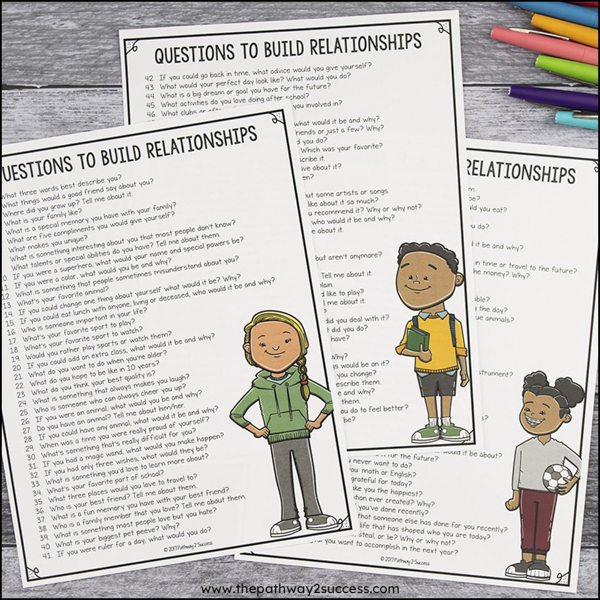
- Hold relationship-building group chats – Use relationship-building questions to get to know kids and teens on a deeper level.
Build Confidence with Independence
When kids and teens feel confident in themselves, they’re better able to take healthy risks like trying something new. They need to know that they can give things a try, even if they might fail or mess up along the way.
- Build confidence with simple and manageable tasks – Begin by providing easier assignments and activities that you know your learner can accomplish. Keep in mind that this isn’t about being “too easy” on kids. Instead, simple tasks are a steppingstone to teach kids that they can accomplish what they put their mind to.
- Assign daily responsibilities – Daily responsibilities build confidence through competence. Give chores to help build confidence, responsibility, and independence over time.
- Incorporate challenges – Find “just right” challenges for kids and teens. This means activities that are challenging enough to be an engaging problem to solve, but not too challenging that make the student want to give up right away. This might include challenging but fun activities puzzles, brain games, escape rooms, and more.
- Give choice when possible – Help kids build confidence in their own decision-making process by giving more choices. This goes for big things like choosing which sport to play for the season, but it goes for little things too. This might look like choosing which book to read or which game to play during free time.
Teach Executive Functioning Skills
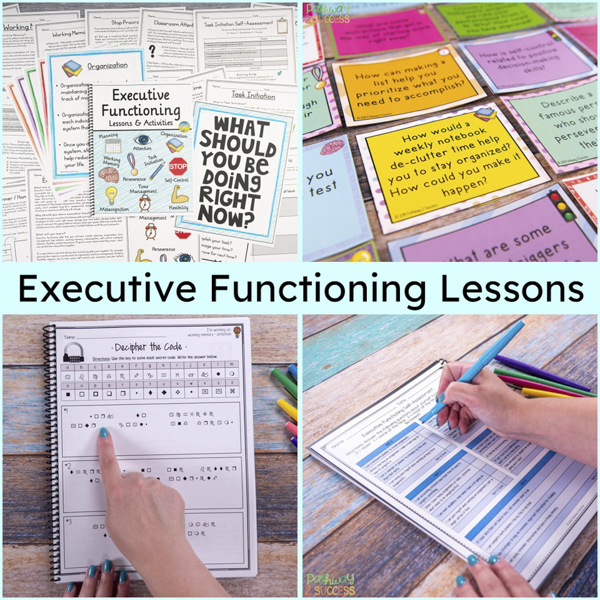
If kids and teens are struggling with executive functioning skills, it’s important to teach these skills directly. This can help kids learn strategies to help them plan, organize, get started on tasks, and problem-solve through challenges.
- Introduce executive functioning skills – It helps for kids and teens to know what executive functioning skills are and why they matter. Explain that these skills help us stay organized, improve focus, plan efficiently, and get started on tasks. They also help us manage our emotions, strengthen our self-control, and even problem-solve through challenges. These abilities help us with everything from completing a science project to playing your best in a big basketball game. Use these free executive functioning worksheets to get started together.
- Teach executive functioning skills directly – It’s important to mention that building executive functioning skills takes time and practice. Dedicate time each day (or week) focused on learning about executive functioning skills and strategies. Whether you work with middle and high school students or elementary learners, we’ve got the executive functioning lessons and activities right for you and your students.
- Play executive functioning games – Games are a great way to target skills like self-control, attention, and mental flexibility. Best of all, you can use games you already might have on hand like Jenga, chess, and Battleship to name a few. You can also add in executive functioning brainteasers for added fun.
- Hold executive functioning chats – Use targeted questions to get kids and teens thinking deeply about executive functioning skills in their lives. The idea is simple: Ask a question, discuss, and learn from each other. For instance, you might ask, “Imagine you have homework and practice at 6pm. What can you do?” This question encourages kids to think about planning, prioritizing, managing stress, and working through challenges. Keep your executive functioning questions on a ring and discuss one whenever you have a spare moment.
- Read executive functioning-focused alouds – Choose books and stories that target executive functioning skills. Keep in mind that read alouds aren’t just for little kids; even older students enjoy listening to a story. Use this detailed list of executive functioning read alouds to get started.
Put Scaffolds and Supports in Place
Scaffolds and supports help set the stage for success.
- Start small – Instead of assigning big tasks, try starting with a small activity to build confidence and motivation. For instance, a simple strategy might be having a student complete only odd numbers on a worksheet instead of the whole thing.
- Integrate accommodations – Consider accommodations to help learners make progress in the right direction. These don’t have to be big changes – sometimes it’s the smallest things like allowing students to write an essay with a gel pen instead of pencil. Stay open-minded and do what works.
- Reduce distractions – Focus makes a huge difference. Learning new habits is challenging enough on its own without distractions in the way. Make an effort to reduce student distractions by reducing clutter and keeping a quiet work area.
Teach Coping Skills
Coping skills are the activities we use to manage stress and tough emotions. Building our “coping skills toolbox” is essential to help cope with working through tough things.
- Practice deep breathing – One of the most foundational coping skills to teach and practice is deep breathing. To give this a try, practice sitting in a comfortable position and slowly breathing in and out. This “pause” might feel odd at first; that’s because we’re not always used to slowly down. Breathe in and out for a few minutes to build calm and focus.
- Practice mindful coloring – Grab some coloring pages and colored pencils to practice mindful coloring. The idea is simple, but not necessarily easy – don’t focus on coloring perfectly. Instead, just color and breathe in and out slowly.
- Practice STOP – Teach kids how to stop what they are doing (S), take a deep breath (T), observe how they feel (O), and plan for how to move forward (P).
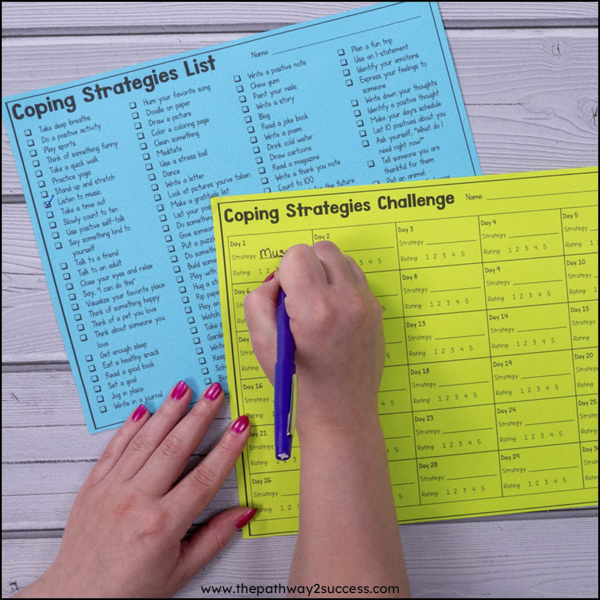
- Try a coping skills challenge together – Introduce many different coping skills with a 30-day coping skills challenge (it’s free!). Since different strategies work for different people, it’s extremely important to give new techniques a try together.
Learn from Failures Together
It’s critically important to see that failure is not the enemy; it’s a tool that helps us learn and grow. Give students opportunities to learn from failures and setbacks together.
- Conference – Meet 1:1 with individual students to reflect on progress. This is especially important after failures and setbacks. You might discuss what went well, what didn’t go well, and what you could do differently the next time.
- Allow re-takes – If a student fails a quiz or notebook check, give them an honest opportunity to re-do it for at least partial credit. You might have a student write a paragraph explaining what they did wrong and how they could do better next time. This isn’t about going “too easy” on students – quite the opposite. It’s about reinforcing the idea that when we fail, it isn’t the end of the road. Struggling kids and teens need to know this so that they can keep trying, even when they mess up along the way.
- Practice reflection 3-2-1 – After a project, quiz, or important task, encourage kids to think about 3 things that went well, 2 things that didn’t go so well, and 1 lesson for the future.
Encourage Self-Compassion
Because failures and setbacks are part of life, self-compassion is necessary. Showing yourself extra kindness isn’t about being “too easy” on yourself. Instead, self-compassion helps you know that you’re on your own side, even when things get tough.
- Discuss self-compassion in real life – Talk about what showing yourself compassion looks like in the moment. For example, imagine you tried out for a play and didn’t get the part you wanted. Instead of saying, “Wow, that was so stupid you even tried out for it. You knew you wouldn’t make it,” you might think something like, “Hey, that didn’t go the way you wanted it to go, but it’s okay. It’s an experience you’re learning from. You really did your best.” Use real-life failures, setbacks, and challenges to model what this looks like in real time together.
- Model and practice positive self-talk – Self-compassion often starts with how we speak to ourselves. Model and practice positive self-talk phrases together. If you need a start with this, try reading from a list of positive thoughts and affirmations together.
- Build mindful pauses into the day – Giving time and space to think helps us cultivate self-compassion. Try to add in a few calming mindful pauses in the day, even if it’s just a few moments before or after transitions.
- Practice writing kind notes to yourself – Spend time writing a thoughtful, supporting, and caring note to yourself. Kids and teens might write about their positive qualities, why they’re a great friend, or something they’re doing great at today.
Teach Self-Advocacy Skills
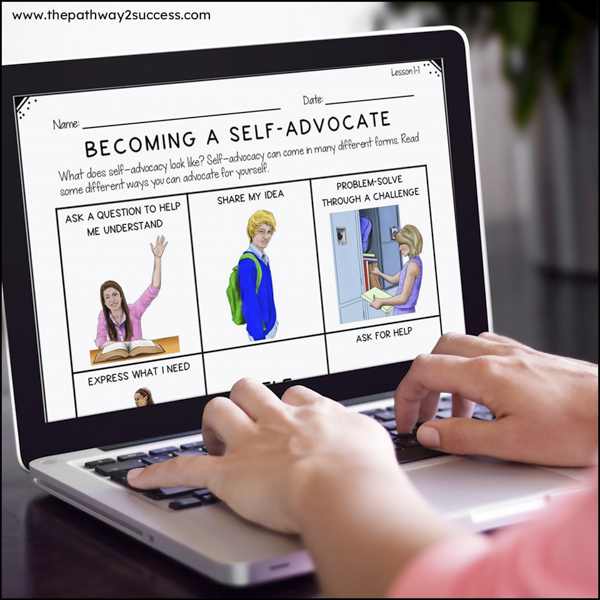
Self-advocacy is speaking up to get your needs met. Many students who struggle with learned helplessness also have difficulty speaking up for themselves. This makes teaching self-advocacy skills a necessary step.
- Teach SUPER self-advocacy skills – SUPER self-advocacy stands for stay calm (S), understand the problem (U), problem-solve (P), express yourself (E), and reflect (R). Teaching, modeling, and practicing each step can help students become better self-advocates now and in the future.
- Practice and discuss self-advocacy scenarios – Read self-advocacy situations and encourage learners to discuss together. For example, “You start your homework at the end of class, and you have no idea how to do the math problems. Why is this a problem? What can you do?”
- Give time to share opinions – Encourage students to be brave and share their own opinions. This helps learners step outside their comfort zone and speak up for themselves, even when others might disagree.
- Teach self-advocacy skills explicitly – Take 10-20 minutes per day (or per week) to teach self-advocacy lessons to kids and teens.
Celebrate Growth and Small Wins
Learning to appreciate wins and growth in the right direction can help students build motivation over time.
- Share weekly wins – Give time at the end of each week for students to share their wins. These can be big wins like making a sports team, but they can be smaller wins too like remembering to bring a pencil to class each day. The idea is that success builds on success.
Working Through Learned Helplessness Together
There is no doubt that working through learned helplessness can be challenging. The good news is that breaking this cycle is achievable with consistent and supportive strategies. As students slowly rebuild their confidence over time, they can learn that they can do challenging things independently.




Leave a Reply