
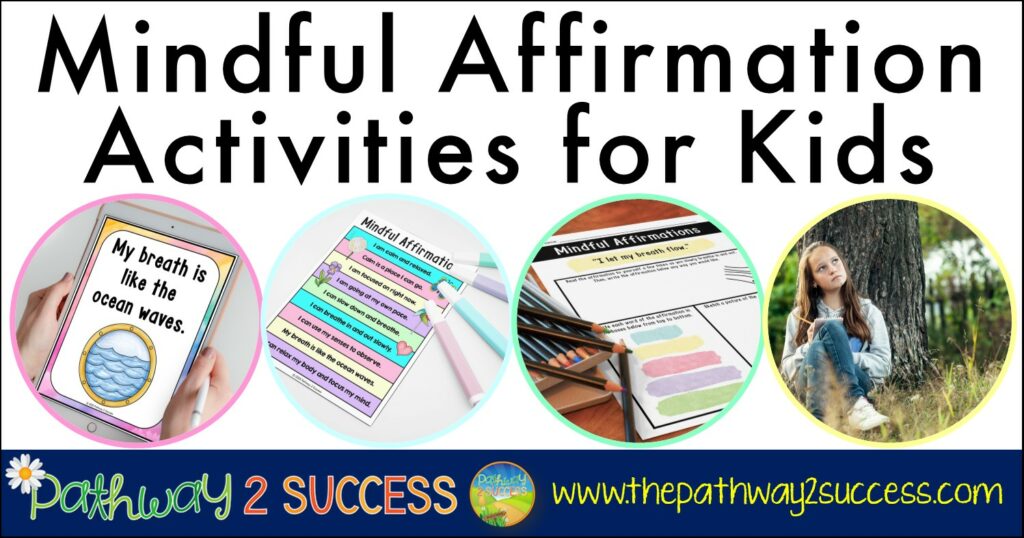
Mindfulness is a powerful tool for kids, teens, and adults alike. In short, mindfulness is the practice of aiming our focus to the present moment. Focusing on the “right now” empowers kids and teens to strengthen their focus, calm their emotions, and ultimately feel their best. While there are many different ways to practice mindfulness, mindful affirmations are a simple, fun, and meaningful strategy to try.
Why practice mindfulness with kids and teens?
Substantial research has shown that mindfulness is a beneficial practice. Here are just a few reasons why it pays off to build a mindful practice with kids and teens:
- Mindfulness can boost attention and focus. By learning to focus on just our breathing or the sensations in our body, mindfulness helps train our minds to focus on one thing at a time. This practice builds our focus muscles, allowing us to also concentrate on other important tasks in our lives.
- Mindfulness gives tools to manage emotions. As the brains of kids and teens grow, the limbic system (our emotional brain) grows more quickly than the prefrontal cortex (the thinking part of our brain). Mindful breathing helps give kids and teens a boost with calming emotions and returning their nervous systems to a more calm state.
- Mindfulness helps activate executive functioning skills. Executive functioning skills are the critical brain-based abilities we use to plan, start tasks, manage our time, and work through challenges. By practicing the ability to focus on the “right now,” we can train our brains to activate our executive functioning skills too.
- Mindfulness can build self-control skills. Self-control is our ability to stop and think before reacting to something. This is particularly challenging for kids and teens with growing brains. Research has shown that practicing mindfulness reduces our emotional reactivity, which means giving space between a trigger and our reaction. In turn, this builds self-control skills.
- Practicing mindfulness increases feelings of overall well-being. How kids and teens feel is important. It is the baseline for how they think and act on a daily basis. Research highlights that mindfulness helps to improve feelings of well-being. Simply put, when kids feel better, they can do better too.
- Mindfulness can build empathy and compassion. Practicing mindfulness provides the chance to pause and consider alternate perspectives. When we do this, we can start to develop empathy for others and compassion for ourselves.
All of these reasons make a strong case that it’s worth it a little extra time to teach mindfulness practices to kids and teens. The truth is that mindfulness is beneficial for all of us!
What are some mindful affirmations to try?
The best part is that there are countless mindful affirmations you can introduce and practice together. Different phrases are going to work best for different people. Different phrases may even work better at different times. For example, before starting a chore or task, a student might say, “I am focused.” That same child might use the phrase, “I am breathe in and out slowly,” when they feel stressed or overwhelmed. It’s about finding what works for each individual. Introducing several different affirmations can help get there.
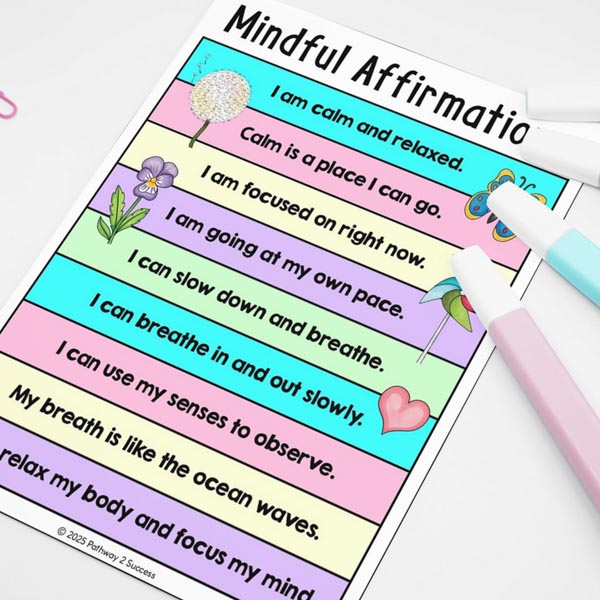
Here are some mindful affirmations to try with kids and teens:
- I am calm and relaxed.
- Calm is a place I can go.
- I am focused on right now.
- I am going at my own pace.
- I can breathe in and out slowly.
- I can use my senses to observe.
- My breath is like the ocean waves.
- I can relax my body and focus my mind.
If you need more ideas, give this free positive affirmations list a try. It comes with a blank page for students to record their favorite sayings.
How can kids practice mindful affirmations?
The key to utilizing mindful affirmations is practice. Once you’ve introduced the idea of mindfulness and mindful affirmations, here are some extra activities to try practicing the phrases:
Recite mindful affirmations
Start by reciting mindful affirmations aloud with kids and teens. Begin with a simple phrase such as, “I am calm and relaxed,” and “Calm is a place I can go.” Say each phrase with sincerity and have students repeat it back. Next, you can have a student lead the affirmations by choosing a phrase and encouraging everyone else repeat it back.
Note that you may also choose different phrases for different situations:
- “I am focused.” – Recite this before a quiz, test, or independent activity.
- “I can slow down and breathe.” – Recite this affirmation after recess, lunch, or anytime to create more calm.
- “I can breathe in and out slowly.” – Try this mindful affirmation for students who are upset and need strategies to feel calm.
Practice mindful breathing affirmations
Combine the power of mindful breathing with affirmations. Guide students through simple breathing exercises like belly breathing or counting your breaths. Then, integrate affirmations by having students repeat a phrase to themselves as they slowly breathe in and out.
For example, you might try, “With each breath in, I am calm. With each breath out, I am strong.” Encourage students to say the phrase in their minds as they slowly breathe in and out.
Journal about mindful affirmations
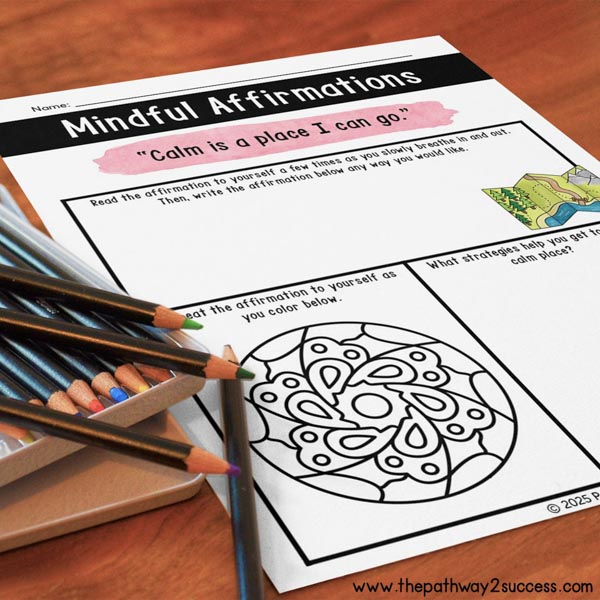
Encourage students to explore each mindful affirmation through writing. Provide prompts for each affirmation such as:
- How does this affirmation make you feel?
- What does this affirmation mean to you?
- When could you use this affirmation?
- Write a story about a time someone could use this affirmation.
Come up with your own journal prompts or use this ready-to-go Mindful Affirmation Journal – it’s filled with over 90 engaging and meaningful mindful affirmation phrases to build confidence, focus, and calm.
Practice mindful movements
Combine affirmations with gentle movements like stretching, yoga postures, or walking meditation. As students move, encourage them to silently repeat the mindful affirmation to themselves. This is a great way to encourage positive self-talk while integrating movement.
Make a mindful affirmation list
As unique individuals, different affirmations are going to work better for different people. Have students write out their own personalized list with their favorite mindful affirmations. Learners can keep these lists in their desk, posted in their locker, or tucked away in their binder.
Visualize mindful affirmations
Use the power of visualization by picturing each affirmation in your mind. For example, start with the affirmation, “My breath is like the ocean waves.” Encourage students to close their eyes and picture the ocean waves as they slowly breathe in and out.

Draw a picture mindful affirmations
Creating an artistic representation of each affirmation goes hand-in-hand with visualizing. Have students first picture the affirmation in their mind and then draw a detailed illustration. Students can even write these on index cards to design their own individualized set of mindful affirmation cards. Learners can then keep the cards with them or leave them in a calm-down area for times they need them the most.




Leave a Reply